DogSTR Research Project
When I joined the Behavioral Ecology Lab at IISER Kolkata during my second year, I expected to learn about animal behavior. What I didn't expect was that I would spend months building robots, observing street dogs, and questioning assumptions I had unknowingly carried for years.
The internship gave me an opportunity to work under Associate Professor Anindita Bhadra and senior Ph.D. scholar Rohan Sarkar on an internationally funded research project focused on understanding how free-ranging street dogs interact with humans.
At first, the project sounded straightforward. Dogs interact with people every day, so studying those interactions seemed relatively simple. The reality was far more fascinating.
The central question we were trying to answer was deceptively simple: when a street dog decides whether to trust, approach, or respond to a human, which cues matter the most? Are they paying more attention to what they see, what they hear, or what they smell?
Answering that question required much more than simply observing dogs from a distance.
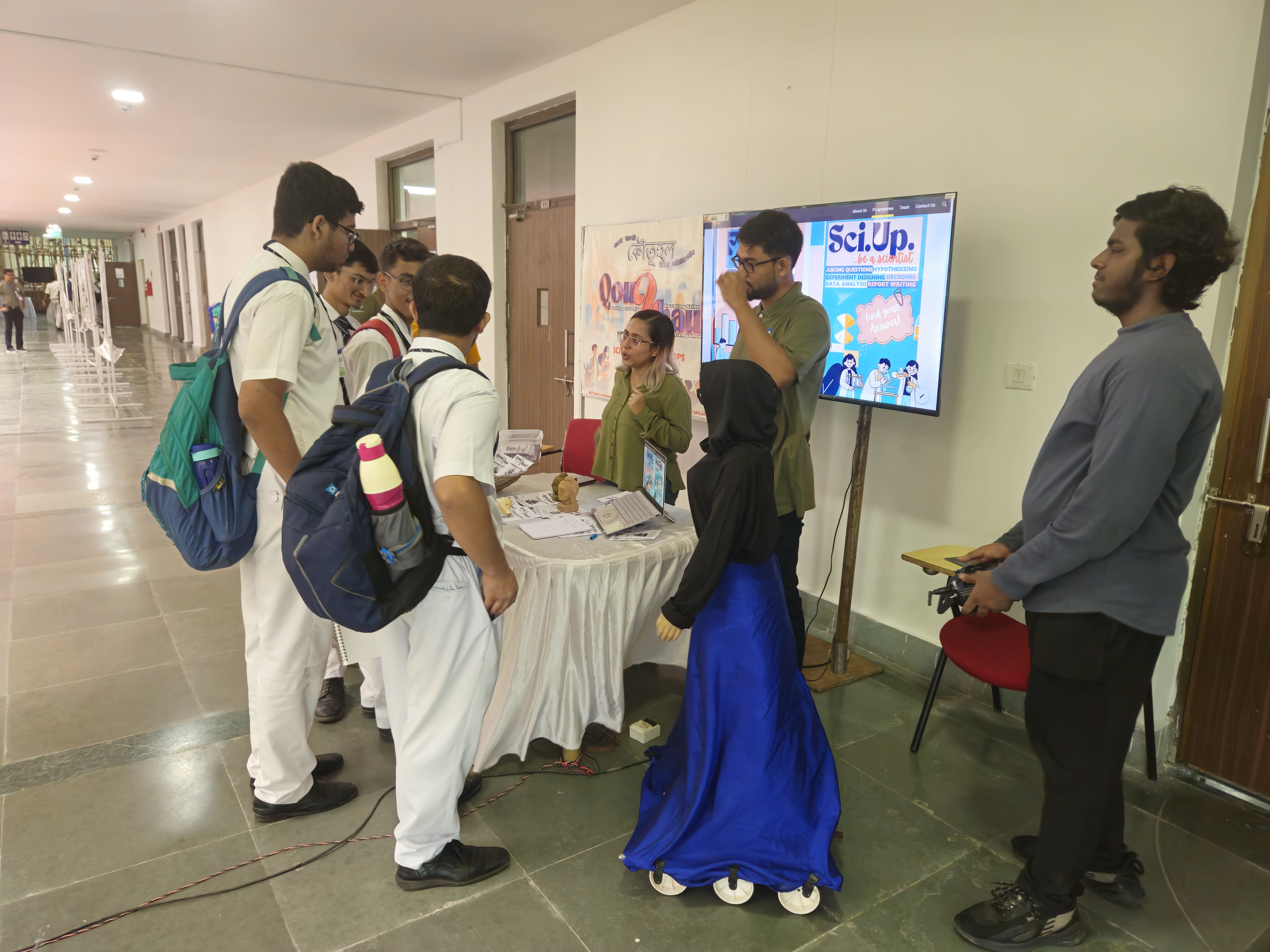
One of the most exciting parts of the project involved working with Arduino-based mobile robots called Dover. These robots became our experimental partners in the field. Our team designed, programmed, maintained, and tested them so they could present controlled visual, auditory, and olfactory cues to free-ranging dogs.
I still remember how unusual it felt during the early stages of the project. As a life science student, I never imagined I would be spending part of my research internship troubleshooting motors, checking batteries, debugging Arduino code, and preparing robots for behavioral experiments. Yet that combination of biology and technology became one of the most rewarding aspects of the entire experience.
Fieldwork itself was equally memorable.
Unlike laboratory animals living in controlled environments, street dogs are independent individuals with their own personalities, territories, and daily routines. Some were curious and immediately approached us. Others maintained their distance and watched carefully before deciding whether we were worth investigating.
This unpredictability was both challenging and fascinating.
To understand their behavior properly, I learned and applied ad libitum sampling techniques. Much of my time was spent carefully observing dogs, recording behavioral responses, identifying individual animals, and learning to recognize subtle body language that most people would probably overlook.
What surprised me most was how much information dogs communicate without making a sound.
Small changes in posture, ear position, movement patterns, or hesitation often revealed far more than obvious behaviors. The more time I spent observing them, the more I realized how complex their decision-making processes really are.
Of course, not everything went according to plan.
Behavioral research rarely does.
Experiments that seemed perfect on paper sometimes failed completely in the field. Environmental conditions changed, dogs behaved in unexpected ways, equipment occasionally needed adjustments, and protocols had to be refined. Those moments taught me that research is rarely a straight path from hypothesis to result. It is a continuous process of observation, adaptation, and improvement.
Perhaps the most valuable lesson from this internship came from working in a truly interdisciplinary environment. The project brought together concepts from behavioral ecology, animal cognition, electronics, programming, experimental design, and statistical thinking. It showed me how meaningful research often happens at the intersection of different fields rather than within a single discipline.
More importantly, it changed how I think about animals.
Before this project, I saw street dogs as a familiar part of everyday life. After spending months observing them closely, I began to appreciate the remarkable cognitive abilities they use to navigate complex human-dominated environments. Their ability to interpret signals, assess risks, form associations, and adapt to constantly changing situations is far more sophisticated than most people realize.
Looking back, this internship was much more than a research project.
It was my first experience contributing to a scientific question whose answer was genuinely unknown. It introduced me to the challenges and excitement of behavioral research, taught me how technology can be integrated into biological studies, and strengthened my appreciation for interdisciplinary science.
Most importantly, it reminded me why I enjoy research in the first place.
There is something incredibly rewarding about asking a question that nobody has fully answered before and then slowly uncovering pieces of that answer through observation, experimentation, and persistence.
And sometimes, those discoveries happen with the help of a robot and a street dog.